
Cheery news always sticks to the top of the Business page, while grimmer news seems to slip into the fold. Housing slows and its, "Home buyers don't have to pull the trigger as fast." An uptick in the jobless rate, "No problem... There is really no negative to put on this." (TNT) I'm here to put the negative on it. And the second Tuesday is now prediction Tuesday for state and local economic numbers.
While the overall economy in Washington will fare better than that of the rest of the country, as we enter the second dip of the Bush recession, state and local revenues will suffer, housing will suffer, and employment will suffer.
Housing
Home sales in most of the state have reached their peak. King County's will top out pretty soon. By this time next year (end of February reports), home prices will be down 5 to 10 percent in King County and 10-20 percent elsewhere in the state. Here are our benchmarks.
Actual February 2006 median home sale prices
King County - $345,000
Pierce County - $250,000
17-County Area * - $283,000
(*covered by Multiple Listing Service)
Predicted February 2007 median home sale prices
King County - $325,000
Pierce County - $220,000
17-County Area - $250,000
Picking the peak of a trend is the most difficult. Things tend to trend over long time periods. Can't find anybody else making predictions about housing. If you see some, drop us a line.
Employment
Employment growth will be nonexistent in Washington over the coming year. That is, zero job growth. I am not going to predict the unemployment rate, because it's been boogered by the Bush team and I haven't got a handle on it.
Background from economist John Williams:
"Richard Nixon had a highly publicized war with the Bureau of Labor Statistics on the unemployment data. Nixon wanted to report the unemployment rate as the lower of the seasonally adjusted or unadjusted number, at any given time, but not specify same to the public. While that approach was unconscionable at the time and never used, basically the same methodology was introduced in 2004 as "state-of-the-art" by the current Bush administration."
I just played with some employment growth v. employment rate figures from the 2006 Economic Report of the President. Clinton added 18.4 million jobs in his eight years. The unemployment rate dropped from 6.9 to 4.0. Bush added a total of 4.8 million jobs in five years, and the unemployment rate rose only to 5.1. Supposedly its down to 4.7 now. Something is very funky. I'll give you a chart next week.
State Revenue
Tax revenue growth has been set at 5% by OFM's chief forecaster Irv Lefberg. I've tried to budge him, but he's sticking to it. (Actually official baseline growth is only 2.2% next year, but it jumps to 5.7 in 2008 and continues at about 5 percent thereafter.) Barring legislative action, revenue will grow substantially slower -- 1.1% short term and 3.0% long term.

Tuesday, March 14, 2006

Sunday, March 12, 2006
Politics, the Heartland, and "Stuff"
Two weeks ago today I was sitting in MSP marveling at the Goose-B-Gone posters and the Fox News bookstore outlets. (I'm not making this up.) I had more than a couple of hours between planes, so I wrote what I thought was a humorous little post about competence. Competence. How the Heartland values competence above all else and how linking GOP governance to the complete absence of competence – a very short link – would make them "the other guys" to a large part of America.
(Yes, I know Minnesota is the other way from South Dakota, but they have jets if you connect in that direction. Through Denver, it's prop planes flying low.)
I made the mistake of showing the post to a cousin whose opinion I value very much. Either the piece wasn't written very well or there's a deep-seated defensiveness I couldn't get by. In any event, the message heard was not that the Heartland cares about competence, but that they don't got any.
That, of course, is not so. Self-reliance and the distance between farms tends to generate ability out of seed corn.
The question turned not on the skill of city mice v. country mice, but on my being willing to wait a couple of days till the weather warmed to start a truck. This was not appropriate respect for a borrowed vehicle. But my goodness, it was minus twenty-six and the hood latch was frozen! (Note: I did start the truck and deliver it full of gas. Saving my reputation, I guess.)
Anyway, it was clear I didn't have the proper respect for property.
Guilty.
Then it hit me. This is what the Heartland cares most about. Even more than competence. This is what citizens of every state care most about. Stuff! Sometimes they even confuse it with the concept of "responsibility."
The upshot is that if we on the Left want to reach these people, we need to promise them more money and give them goodies. That means we're in trouble. We can promise the poor sufficience. The moderately well off can keep their stuff. The rich? We'll debate that later. But more? More material is not sustainable. No.
It is absolutely astounding how many of our fellow citizens spend all or most of their time obtaining, storing, cleaning, maintaining, insuring and displaying material goods. These are citizens we are not going to reach with messages on the environment, education, poverty, justice, civil liberties, women's rights, workers' rights, geopolitical balance, health care, or any of the other issues that matter and that the Radical Right is screwing up. Why? Because these citizens think all this noise is just an excuse to get them to give up some of their stuff.
That, or because they can't hear us. They're at the goddam mall getting more stuff or exchanging this stuff for that stuff.
There's a line called "object referral" in Hindu thought which says people will identify who they are by the things they own. A BMW owner is better than a Ford owner. Who are you? I'm a BMW owner. And driver. I live in a house in Sahalee. I'm an Ipod user. I'm a boat owner. I show horses. New shoes? Yes. You like them? Etc., etc. Who they really are is another discussion, but be sure, a person is not any aspect of a material thing through the mechanism of ownership.
Studies have shown that when it comes to material possessions and happiness, it is not the absolute level of possessions that contributes to subjective measures of happiness, it is the relative level. So if your mud hut has a better roof than your neighbor's, you are just as happy as if your garage has a BMW and Jim has to park his Jetta on the street.
Even the boys from the Black Hills tend to look at your pickup before they look at your face. The assembly of things in the shed often seems analogous to the phalanx of servants at the door in an earlier age.
But I ascribe virtue to myself where there is simply a missed gene. I have never understood the fever for stuff. Just like I never got disco, or even the Stones. I take some heart that the most gifted economist of the 20th century John Maynard Keynes did not have a material view of the world either, or an academic one, for that matter. According to Joan Robinson, another first-tier economist, Keynes had an aesthetic view of economies. Poverty was ugly. Unemployment was stupid.
My cousin said to me, "You keep right on with that political B.S., Al. I got business to take care of. But thanks for watching my back."
What he meant, I'm not sure. I have the image of watching the back of an ostrich. Ten years from now if he looks up and sees things are not like what he expected, he is going to get very excited. Is he going to have the wit to blame the right party, or will he just pick the closest one?
(Yes, I know Minnesota is the other way from South Dakota, but they have jets if you connect in that direction. Through Denver, it's prop planes flying low.)
I made the mistake of showing the post to a cousin whose opinion I value very much. Either the piece wasn't written very well or there's a deep-seated defensiveness I couldn't get by. In any event, the message heard was not that the Heartland cares about competence, but that they don't got any.
That, of course, is not so. Self-reliance and the distance between farms tends to generate ability out of seed corn.
The question turned not on the skill of city mice v. country mice, but on my being willing to wait a couple of days till the weather warmed to start a truck. This was not appropriate respect for a borrowed vehicle. But my goodness, it was minus twenty-six and the hood latch was frozen! (Note: I did start the truck and deliver it full of gas. Saving my reputation, I guess.)
Anyway, it was clear I didn't have the proper respect for property.
Guilty.
Then it hit me. This is what the Heartland cares most about. Even more than competence. This is what citizens of every state care most about. Stuff! Sometimes they even confuse it with the concept of "responsibility."
The upshot is that if we on the Left want to reach these people, we need to promise them more money and give them goodies. That means we're in trouble. We can promise the poor sufficience. The moderately well off can keep their stuff. The rich? We'll debate that later. But more? More material is not sustainable. No.
It is absolutely astounding how many of our fellow citizens spend all or most of their time obtaining, storing, cleaning, maintaining, insuring and displaying material goods. These are citizens we are not going to reach with messages on the environment, education, poverty, justice, civil liberties, women's rights, workers' rights, geopolitical balance, health care, or any of the other issues that matter and that the Radical Right is screwing up. Why? Because these citizens think all this noise is just an excuse to get them to give up some of their stuff.
That, or because they can't hear us. They're at the goddam mall getting more stuff or exchanging this stuff for that stuff.
There's a line called "object referral" in Hindu thought which says people will identify who they are by the things they own. A BMW owner is better than a Ford owner. Who are you? I'm a BMW owner. And driver. I live in a house in Sahalee. I'm an Ipod user. I'm a boat owner. I show horses. New shoes? Yes. You like them? Etc., etc. Who they really are is another discussion, but be sure, a person is not any aspect of a material thing through the mechanism of ownership.
Studies have shown that when it comes to material possessions and happiness, it is not the absolute level of possessions that contributes to subjective measures of happiness, it is the relative level. So if your mud hut has a better roof than your neighbor's, you are just as happy as if your garage has a BMW and Jim has to park his Jetta on the street.
Even the boys from the Black Hills tend to look at your pickup before they look at your face. The assembly of things in the shed often seems analogous to the phalanx of servants at the door in an earlier age.
But I ascribe virtue to myself where there is simply a missed gene. I have never understood the fever for stuff. Just like I never got disco, or even the Stones. I take some heart that the most gifted economist of the 20th century John Maynard Keynes did not have a material view of the world either, or an academic one, for that matter. According to Joan Robinson, another first-tier economist, Keynes had an aesthetic view of economies. Poverty was ugly. Unemployment was stupid.
My cousin said to me, "You keep right on with that political B.S., Al. I got business to take care of. But thanks for watching my back."
What he meant, I'm not sure. I have the image of watching the back of an ostrich. Ten years from now if he looks up and sees things are not like what he expected, he is going to get very excited. Is he going to have the wit to blame the right party, or will he just pick the closest one?
Saturday, March 11, 2006
Fudging the numbers, scripting the happy talk
Available today at this link is an interview with John Williams, a Republican kind of guy and an economist who has been tracking how government statistics have diverged from reality over time. His Shadow Government Statistics project displays a much different economy than the official figures, an economy more like the one you and I experience. The cherry picking of numbers I razzed EPI about last week is a sneeze to the finagling of officials' hurricane.
Inflation, for example, is systematically understated, and has been since the early 1990s. Williams estimates about 2.7% should be added to official inflation figures to compensate for dubious statistical tricks. The consumer price index (CPI) should be at 7%, rather than the official 4%. Particularly annoying to Williams is the geometric weighting of the CPI, a scheme devised by Alan Greenspan and George I's chief economist Michael Boskin, and later incorporated into official numbers under Bill Clinton.
Inflation was previously measured by checking the price of a fixed "basket" of goods from one period to the next, a collection of goods such as might be purchased by an average consumer. Under the Greenspan/Boskin scheme, the substitution effect was incorporated. The idea is when steak gets too expensive, people will substitute hamburger, so hamburger instead of steak should be in the basket. The price of the basket with hamburger is, of course, not so expensive as the basket with steak, so inflation does not rise so much. In other words, the CPI has become the price rise of a deteriorating standard of living.
Other clever means of suppressing inflation include "hedonics," from the same root as hedonism, which allows products which have improved in quality – say a washer with electronic controls as opposed to twist dials – to be valued at a lower price. The theory is they are not perfectly comparable.
Williams dismisses out of hand any claim to legitimacy such machinations have, but he says the exercise was not primarily to amuse voters around election time, though this was definitely a welcome adjunct. No, the real intent was to reduce the payments and obligation sunder Social Security, since these are tied to the CPI. And it has done that. Williams suggests that if all the tricks and their cumulative effects were reversed, payments to Social Security recipients would be 43% higher.
Equally insidious, however, is the tendency of this operation to overstate economic growth. The most popular economic measurement is the growth of real GDP, real meaning inflation-adjusted. If inflation is understated, real GDP is overstated. (Maybe you just count the "for rent" and "for sale" signs.)
By Williams calculations, the economy is on the verge of the second part of a double dip recession, and may already be in contraction. Inflation is 7%. And unemployment – as measured by the formula of the Depression years – is running at 12%.
In some parts, maybe he is over the top. Using accrual accounting for Social Security is not particularly apt. But Williams adjustments do make the numbers and the experience of the average working person come into the same picture.
Inflation, for example, is systematically understated, and has been since the early 1990s. Williams estimates about 2.7% should be added to official inflation figures to compensate for dubious statistical tricks. The consumer price index (CPI) should be at 7%, rather than the official 4%. Particularly annoying to Williams is the geometric weighting of the CPI, a scheme devised by Alan Greenspan and George I's chief economist Michael Boskin, and later incorporated into official numbers under Bill Clinton.
Inflation was previously measured by checking the price of a fixed "basket" of goods from one period to the next, a collection of goods such as might be purchased by an average consumer. Under the Greenspan/Boskin scheme, the substitution effect was incorporated. The idea is when steak gets too expensive, people will substitute hamburger, so hamburger instead of steak should be in the basket. The price of the basket with hamburger is, of course, not so expensive as the basket with steak, so inflation does not rise so much. In other words, the CPI has become the price rise of a deteriorating standard of living.
Other clever means of suppressing inflation include "hedonics," from the same root as hedonism, which allows products which have improved in quality – say a washer with electronic controls as opposed to twist dials – to be valued at a lower price. The theory is they are not perfectly comparable.
Williams dismisses out of hand any claim to legitimacy such machinations have, but he says the exercise was not primarily to amuse voters around election time, though this was definitely a welcome adjunct. No, the real intent was to reduce the payments and obligation sunder Social Security, since these are tied to the CPI. And it has done that. Williams suggests that if all the tricks and their cumulative effects were reversed, payments to Social Security recipients would be 43% higher.
Equally insidious, however, is the tendency of this operation to overstate economic growth. The most popular economic measurement is the growth of real GDP, real meaning inflation-adjusted. If inflation is understated, real GDP is overstated. (Maybe you just count the "for rent" and "for sale" signs.)
By Williams calculations, the economy is on the verge of the second part of a double dip recession, and may already be in contraction. Inflation is 7%. And unemployment – as measured by the formula of the Depression years – is running at 12%.
In some parts, maybe he is over the top. Using accrual accounting for Social Security is not particularly apt. But Williams adjustments do make the numbers and the experience of the average working person come into the same picture.
Friday, March 10, 2006
Tacoma Taxk Force Underway
Tacoma's Revenue Task Force is accelerating rapidly. We may not be going very fast yet, but considering we started at zero mph, the acceleration is great.
The City Services Tax Task Force was nominally created by the city council, but more by the effort of new city manager Eric Anderson. He wasn't on the job six months before he recognized the long-term squeeze Tim Eyman and the rest of the deadbeat dads have put on the city's revenue.
At our first meeting we introduced ourselves and listened to the Finance Director and pretended we knew what we were supposed to be doing. At the second we heard from Anderson and got some of our own ideas on the table.
Anderson carried in from Iowa and Illinois an idea of spreading the cost of basic city services – police and fire – to all those who benefit. Seemingly an admirable sentiment, except when those free riders are powerful nonprofits like hospitals and private universities. In an earlier life, it had been Northwestern University. Anderson tried to enact a tuition tax, and "it took four days for the legislature to pass a bill outlawing the idea."
In Tacoma, it's the University of Puget Sound and the hospitals surrounding Wright Park. Two people from UPS are on the task force, David Droge, a professor in small group dynamics and task force chair, and John Hickey, from the business office. Nonprofits have two representatives as well, Liz Heath and Mike Renner.
Anyway, Anderson's idea of extending taxation to nonprofits is going to get a severe review. (Prior to our meeting with Anderson last week we were set to see a video on property tax. The television showed a few seconds of the news as the video was being cued. The image was of the effigy of somebody, maybe George Bush, in flames. "That's part of our video," Anderson said. "Right after my last meeting with the nonprofits.")
To me, anyway, the key is not the nonprofits, although the idea of taxing them is certainly the issue arousing the most heated debate. The big ones can afford to help the city out. The little ones we can let go. There's not enough revenue there to make it worth trying to collect anyway.
The key is Anderson's idea of using the property tax as the vehicle. At the outset, we need the okay of the legislature to tax the property of nonprofits. It's allowed, but only to fire districts. Then he proposes abandoning the city's B&O, abandoning the city's 1% of the sales tax, and expanding the property base by the holdings of the nonprofits. This new base would be responsible for perhaps 75% of the city's general fund expenditures. Since right now the property tax is only about one-fifth of revenues, even if nonprofits expand the base 30 percent as Anderson estimates, the shift of the load means a bump up in the rate of 2.3x.
Billing monthly is part of the plan, and that would take away some of the sting, but not enough to get by the voters, I'm afraid. And it will need to go past the voters, not only at the beginning, but periodically. That's the last part of the scheme, to submit increases to a "city services referendum" periodically to the voters, allowing them to choose whether they want the services or the few dollars a month they'd save.
There are two other major troubles connected to a big shift to a property tax base. First, the size of the increase would mean a renegotiation of tens of thousands of private contracts between landlords and tenants. Not a happy event for either party. Second, the property tax is not exportable. Tacoma residents traveling to Seattle to shop leave a little in the kitty in the form of the sales tax. Seattle residents in Tacoma should return the favor. Likewise, the B&O tax is collected from businesses operating in the city, whether or not they have property here. The property tax, by contrast, is paid almost exclusively by Tacoma.
I have an alternative based on using both the B&O and property taxes which retains the advantages of transparency and accountability from the Anderson proposal. I'll post it or a link to it after I submit it to the group next week.
One good thing, we changed the name from the City Services Tax Task Force to the Revenue Task Force. Try saying City Services Tax Task Force.
The City Services Tax Task Force was nominally created by the city council, but more by the effort of new city manager Eric Anderson. He wasn't on the job six months before he recognized the long-term squeeze Tim Eyman and the rest of the deadbeat dads have put on the city's revenue.
At our first meeting we introduced ourselves and listened to the Finance Director and pretended we knew what we were supposed to be doing. At the second we heard from Anderson and got some of our own ideas on the table.
Anderson carried in from Iowa and Illinois an idea of spreading the cost of basic city services – police and fire – to all those who benefit. Seemingly an admirable sentiment, except when those free riders are powerful nonprofits like hospitals and private universities. In an earlier life, it had been Northwestern University. Anderson tried to enact a tuition tax, and "it took four days for the legislature to pass a bill outlawing the idea."
In Tacoma, it's the University of Puget Sound and the hospitals surrounding Wright Park. Two people from UPS are on the task force, David Droge, a professor in small group dynamics and task force chair, and John Hickey, from the business office. Nonprofits have two representatives as well, Liz Heath and Mike Renner.
Anyway, Anderson's idea of extending taxation to nonprofits is going to get a severe review. (Prior to our meeting with Anderson last week we were set to see a video on property tax. The television showed a few seconds of the news as the video was being cued. The image was of the effigy of somebody, maybe George Bush, in flames. "That's part of our video," Anderson said. "Right after my last meeting with the nonprofits.")
To me, anyway, the key is not the nonprofits, although the idea of taxing them is certainly the issue arousing the most heated debate. The big ones can afford to help the city out. The little ones we can let go. There's not enough revenue there to make it worth trying to collect anyway.
The key is Anderson's idea of using the property tax as the vehicle. At the outset, we need the okay of the legislature to tax the property of nonprofits. It's allowed, but only to fire districts. Then he proposes abandoning the city's B&O, abandoning the city's 1% of the sales tax, and expanding the property base by the holdings of the nonprofits. This new base would be responsible for perhaps 75% of the city's general fund expenditures. Since right now the property tax is only about one-fifth of revenues, even if nonprofits expand the base 30 percent as Anderson estimates, the shift of the load means a bump up in the rate of 2.3x.
Billing monthly is part of the plan, and that would take away some of the sting, but not enough to get by the voters, I'm afraid. And it will need to go past the voters, not only at the beginning, but periodically. That's the last part of the scheme, to submit increases to a "city services referendum" periodically to the voters, allowing them to choose whether they want the services or the few dollars a month they'd save.
There are two other major troubles connected to a big shift to a property tax base. First, the size of the increase would mean a renegotiation of tens of thousands of private contracts between landlords and tenants. Not a happy event for either party. Second, the property tax is not exportable. Tacoma residents traveling to Seattle to shop leave a little in the kitty in the form of the sales tax. Seattle residents in Tacoma should return the favor. Likewise, the B&O tax is collected from businesses operating in the city, whether or not they have property here. The property tax, by contrast, is paid almost exclusively by Tacoma.
I have an alternative based on using both the B&O and property taxes which retains the advantages of transparency and accountability from the Anderson proposal. I'll post it or a link to it after I submit it to the group next week.
One good thing, we changed the name from the City Services Tax Task Force to the Revenue Task Force. Try saying City Services Tax Task Force.
Tuesday, March 7, 2006
Economy on meth, but it's smiling
The difficulty in communicating the true condition of our economy to the larger public lies in the fact that the rotting walls are concealed behind flowery wallpaper. Enormous federal and private borrowing have created an artificial demand which obscures the decay. It won't take much of a tremor to severely damage the structure. Even the current tepid situation cannot be sustained, much less built upon. But there is demand, and the house hasn't fallen apart yet.
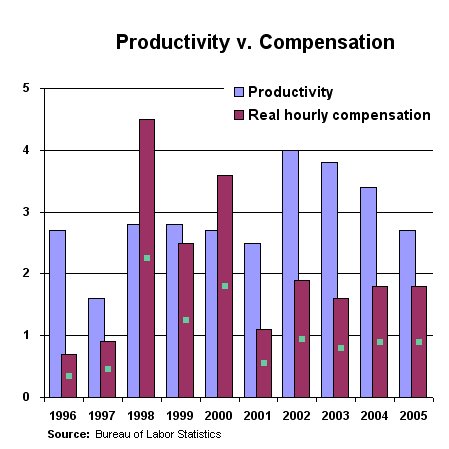
Because many on the left are convinced of the underlying weakness of the Bush economy, we sometimes fudge the numbers to show it. An EPI snapshot last week compared productivity to income and net worth. The period 1998-2001 was compared with the next three year period 2001-2004. Not surprisingly the boom years of the late 1990s treated people better than the best years following Bush's tax breaks for the rich. But it looks suspicious when we cherry pick the time periods.
I won't reproduce the chart for fear of copyright infringement, but the sums are Productivity 8.2% v. 11.7%, first period v. second, and Median Family Income 9.5% v. 1.6%. A bit more ambiguity occurs if you look at the stream of productivity vs. real hourly compensation, as below.
The underlying point is valid. Under Bush and the corporate domination of government and the economy, the fruit of productivity increases has been stolen from working people. Ravi Batra has made the wage-productivity gap a cornerstone of his analysis. This is an intriguing if not completely convincing tack, and certainly points in the inevitable direction. One should also note that productivity can be got by several means, one of which is cutting hours and producing the same product. Hours suffered under the Bush regime.
Economic understanding is at a postwar low, however, and even after six years of bullshit and spin, with massive deficits and little to show for it, Bush has not needed to change his line. His doofus economics still gets a hearing.
"Losing jobs is painful, so let's make sure people are educated so they can find – fill the jobs of the 21st century. And let's make sure there's pro-growth economic policies in place. What does that mean? That means low taxes; it means less regulation; it means fewer lawsuits; it means wise energy policy."
... pitiful.
Saturday, March 4, 2006
Capitalism, the Movie
And they call us starry eyed idealists.
"Laughable and Simplistic" - Cleveland Star
Fantasy and the business world - Des Moines Plain Dealer
Outrageously inaccurate - Kansas City Register
Fortunately most moviegoers are less credulous than Clive Crook in the latest Atlantic. Clive tells a story much more inane than the sappiest Pollyanna about the virtues of capitalism. He ends with the moral, "It will all be okay if we only believe." It is the tired and trite tale of how government interference screws up the free and efficient operation of business. That which brought us our immense prosperity and abundance falters only because of unnecessary meddling.
Clive is frustrated because he cannot find anyone – not economists, not corporate leaders, not even their conservative mouthpieces in Congress – to support him.
Economists are reluctant to get on board because they know the same hands off free market capitalism that infatuates Clive actually brought us the Great Depression and the similar economic "panics" of the years prior to World War II. Only after the rise of Big Government and the moderation of business's domination of markets did fairly steady increases in prosperity begin.
"Competitive markets are great, but you can't make any money in them," say the corporate leaders. "Instead let us dominate markets and something will somehow trickle down to you. What's good for GM is good for the US, don't you know."
Only a few beady-eyed folks in tinfoil hats actually press our elected representatives for more free markets. Instead Congress and state legislatures are begged by business for more tax breaks and market protections, and entreated by consumers and labor for relief from corporate predation.
Is it the marketplace which created prosperity, cloning itself into ever higher forms? Or was prosperity seeded, watered and pollinated by public education, publically financed railroads and transportation systems, more or less uniform laws, systematic regulation of those precious markets, and of course, research universities and government-led space and defense projects?
The successful economies today are not those where the invisible hand swings most freely, but those of Scandinavia, where there are two hands clapping, where public research and develpment augments private. Where social security is social and secure.
The root of Clive's distress is his continuing confusion between the corporate capitalism that exists in the world today and the free market capitalism that exists in the minds of people who need to get out more. The difference between the two is night and day, not degrees of inflection.
The incredible market failure in Oil is a current example. Immense environmental and geopolitical costs are invisible to the market price of fuel, which thus results in a massive subsidy of our own destruction. Hands off these corporations in the name of free markets is like saying, Hands off serial killers in the name of animal rights.
"Laughable and Simplistic" - Cleveland Star
Fantasy and the business world - Des Moines Plain Dealer
Outrageously inaccurate - Kansas City Register
Fortunately most moviegoers are less credulous than Clive Crook in the latest Atlantic. Clive tells a story much more inane than the sappiest Pollyanna about the virtues of capitalism. He ends with the moral, "It will all be okay if we only believe." It is the tired and trite tale of how government interference screws up the free and efficient operation of business. That which brought us our immense prosperity and abundance falters only because of unnecessary meddling.
Clive is frustrated because he cannot find anyone – not economists, not corporate leaders, not even their conservative mouthpieces in Congress – to support him.
Economists are reluctant to get on board because they know the same hands off free market capitalism that infatuates Clive actually brought us the Great Depression and the similar economic "panics" of the years prior to World War II. Only after the rise of Big Government and the moderation of business's domination of markets did fairly steady increases in prosperity begin.
"Competitive markets are great, but you can't make any money in them," say the corporate leaders. "Instead let us dominate markets and something will somehow trickle down to you. What's good for GM is good for the US, don't you know."
Only a few beady-eyed folks in tinfoil hats actually press our elected representatives for more free markets. Instead Congress and state legislatures are begged by business for more tax breaks and market protections, and entreated by consumers and labor for relief from corporate predation.
Is it the marketplace which created prosperity, cloning itself into ever higher forms? Or was prosperity seeded, watered and pollinated by public education, publically financed railroads and transportation systems, more or less uniform laws, systematic regulation of those precious markets, and of course, research universities and government-led space and defense projects?
The successful economies today are not those where the invisible hand swings most freely, but those of Scandinavia, where there are two hands clapping, where public research and develpment augments private. Where social security is social and secure.
The root of Clive's distress is his continuing confusion between the corporate capitalism that exists in the world today and the free market capitalism that exists in the minds of people who need to get out more. The difference between the two is night and day, not degrees of inflection.
The incredible market failure in Oil is a current example. Immense environmental and geopolitical costs are invisible to the market price of fuel, which thus results in a massive subsidy of our own destruction. Hands off these corporations in the name of free markets is like saying, Hands off serial killers in the name of animal rights.
Wednesday, March 1, 2006
Deserting the ship, Neocons jump
Last week, Al Franken talked about a Neocon confession written for the NYT Magazine by Francis Fukuyama, an instructor at John Hopkins University and apparently a noted Neocon. ("After Neoconservatism," New York Times Magazine, 2.19.06.) I had to pick it up.
I was disappointed. I was thrilled. I was perplexed.
As an intellectual foundation, this is beach sand. Neocons knocked down the gate with their big budget spin machines and this is all they have? They didn't use Occam's Razor, they used Occam's Silly String. Rather than work from evidence to conclusions, Neocon thinking runs from conclusions to a misapprehension of the facts. And there is no economic part of it.
You can get an idea of where they were, when after an apparently long trip of self-searching Fukuyama expresses this as an epiphany: "Good governance, which involves not just democracy but also the rule of law and economic development, is critical to a host of outcomes we desire ...."
Actually, that is the outcome we should desire. But he never really gets the point, because this "democracy" of which he speaks is a top-down version provided by the "benevolent hegemon," i.e., the U.S. Real democracy never penetrates his thinking.
In the category of strange discoveries:
Neoconservatism was begun by a cadre of New York intellectuals in the late 1930s and early 1940s, many of whom started out as Trotskyites. Being disillusioned by Stalin's dictatorship, they extracted lessons and applied them to the pragmatic liberalism that informed this country's development from FDR until Reagan.
Later in the piece, Fukuyama identifies a position articulated by Neocon authors as "Leninist." "They believed that history can be pushed along with the right application of power and will. Leninism was a tragedy in its Bolshevik version, and it has returned as a farce when practiced by the United States."
He does point out that Americans who wanted to defend the country from nuclear attack – Jackson Democrats, he calls them – do not have the same appetite for a war to promote Democracy for the godless, or at least Falwell-less.
The "benevolent hegemony" which I always assumed was an affectation of arrogance invisible to its practitioners is actually a conscious program. The following is a tenet from one of the texts: "It is precisely because American foreign policy is infused with an unusually high degree of morality that other nations find they have less to fear from its otherwise daunting power."
Obviously this was written before the Iraq War, but still ... can it be that where I assumed was a cynical and ruthless pursuit of parochial interests was instead this Pollyana foolishness?
No. It can't be. This intellectual base is so weak that it rose to power only on the strength of Texas Oil and a corporate coup d'etat led by Dubya and Cheney. Any theoretical pretensions are simply a fig leaf to cover the Right's doing what it wants to do because it has the power to do it. It is similar to Reagan and Supply Side economics. Supply Side is a totally fatuous proposition based on the idea that the only incentives that work are big incentives for those already at the top. But Reagan wanted to spend himself silly and cut taxes at the same time, so he raised the Laffer Curve from the back of a napkin to national policy. (The Laffer Curve described how cutting taxes can increase revenue. Don't Laff, Dubya is blowing the same smoke today.)
Near the end of the piece, Fukuyama rises to the full extent of his professorial frame and announces, "Neoconservatism, as both a political symbol and a body of thought, has evolved into something I can no longer support." Then he trots off down the anchor chain and into the dockside warehouses.
I have the feeling that he didn't know this wouldn't work only because up till now nobody has been dumb enough to try it.
I was disappointed. I was thrilled. I was perplexed.
As an intellectual foundation, this is beach sand. Neocons knocked down the gate with their big budget spin machines and this is all they have? They didn't use Occam's Razor, they used Occam's Silly String. Rather than work from evidence to conclusions, Neocon thinking runs from conclusions to a misapprehension of the facts. And there is no economic part of it.
You can get an idea of where they were, when after an apparently long trip of self-searching Fukuyama expresses this as an epiphany: "Good governance, which involves not just democracy but also the rule of law and economic development, is critical to a host of outcomes we desire ...."
Actually, that is the outcome we should desire. But he never really gets the point, because this "democracy" of which he speaks is a top-down version provided by the "benevolent hegemon," i.e., the U.S. Real democracy never penetrates his thinking.
In the category of strange discoveries:
Neoconservatism was begun by a cadre of New York intellectuals in the late 1930s and early 1940s, many of whom started out as Trotskyites. Being disillusioned by Stalin's dictatorship, they extracted lessons and applied them to the pragmatic liberalism that informed this country's development from FDR until Reagan.
Later in the piece, Fukuyama identifies a position articulated by Neocon authors as "Leninist." "They believed that history can be pushed along with the right application of power and will. Leninism was a tragedy in its Bolshevik version, and it has returned as a farce when practiced by the United States."
He does point out that Americans who wanted to defend the country from nuclear attack – Jackson Democrats, he calls them – do not have the same appetite for a war to promote Democracy for the godless, or at least Falwell-less.
The "benevolent hegemony" which I always assumed was an affectation of arrogance invisible to its practitioners is actually a conscious program. The following is a tenet from one of the texts: "It is precisely because American foreign policy is infused with an unusually high degree of morality that other nations find they have less to fear from its otherwise daunting power."
Obviously this was written before the Iraq War, but still ... can it be that where I assumed was a cynical and ruthless pursuit of parochial interests was instead this Pollyana foolishness?
No. It can't be. This intellectual base is so weak that it rose to power only on the strength of Texas Oil and a corporate coup d'etat led by Dubya and Cheney. Any theoretical pretensions are simply a fig leaf to cover the Right's doing what it wants to do because it has the power to do it. It is similar to Reagan and Supply Side economics. Supply Side is a totally fatuous proposition based on the idea that the only incentives that work are big incentives for those already at the top. But Reagan wanted to spend himself silly and cut taxes at the same time, so he raised the Laffer Curve from the back of a napkin to national policy. (The Laffer Curve described how cutting taxes can increase revenue. Don't Laff, Dubya is blowing the same smoke today.)
Near the end of the piece, Fukuyama rises to the full extent of his professorial frame and announces, "Neoconservatism, as both a political symbol and a body of thought, has evolved into something I can no longer support." Then he trots off down the anchor chain and into the dockside warehouses.
I have the feeling that he didn't know this wouldn't work only because up till now nobody has been dumb enough to try it.
Subscribe to:
Posts (Atom)