
Former Democrat Joe Lieberman lost no time in aligning himself with his new party, trotting out the long-discredited Bush association between Iraq and 9-11, and trying to paste it onto the airline bomb plot uncovered by the British.
A few questions for the former Democrat might clear things up. (The correct answers are in parentheses.)
How many Iraqis were involved in the airline bomb conspiracy?
(None)
How many from American allies?
(All)
What is the connection between the airline bomb plot and Iraq?
(None)
Will the British put the plotters in Gitmo?
(No)
Will they be subject to torture?
(No)
But even innocent people are "disappeared" and subject to torture, we know these guys are guilty.
(No response)
Is Karl Rove handling your PR now?
(He's certainly offered to).

Friday, August 11, 2006

Saturday, August 5, 2006
Saturday at the Races - Polls and Trolls
Joe Lieberman is trailing by six lengths going down the stretch, but the race in Connecticut isn't over yet. (The Quinnipiac Poll puts it at 54-41 Lamont). An LA Times poll shows that the environment is a winner for Democrats, with the issue growing in concern to voters and Democrats seen as best able to address the problem of global warming, by 49-12.
The real eye-opener is an NPR poll aggregating the 50 most competitive Congressional Districts (40 Republican, 1 Independent, 9 Democrat):
Bush's approval-disapproval ratings have held steady since June at around -20 (58 approve, 38 disapprove) in an average of five polls. This is a plateau (or an underwater shelf) after a steep slide which began in January.
Larry J. Sabato at UVA publishes his Crystal Ball, which seems to be clearing a bit for him. Only a month ago he was predicting just a "micro-wave" for the Democrats. Now it's up to a net gain of 12-15 House seats and 3-6 Senate seats. It needs to go higher.
Donkey Rising reports that voter turnout efforts by Democrats, including the DNC, may be a weak link on election day. Nancy Pelosi, among others, has been critical. One long-time operative said, "The last-minute, throw-money-at-it approach ... does not really solve the fundamental failure to organize .... The DNC is moving in the right direction, but needs to do more, fast."
In Washington, Darcy Burner is doing well enough that push-pollers (negative calls disguised as polling) have been reported already.
Peter Goldmark may get some more serious help now that he is showing well v. Cathy McMorris in the 5th District, despite low name recognition.
Richard Wright in the 4th has Bush-DeLay front man Doc Hastings for an opponent. It has been a major advantage for other Democrats to run against lock-step Republicans, since Bush is not polling well anywhere and the Democratic message is still vague in the voter's ear.
How is the economy doing in the race?
Ginning the till at election time is a campaign strategy perfected by Richard Nixon, and it has been a staple of national politics since (excepting Jimmy Carter), under the rubric "political business cycle." "It's the economy, stupid," was Bill Clinton's ubiquitous message to his staffers in the win over the first Bush. So what's up in the polls?
There's no doubt, the opportunity is here for Democrats, and the fight will be a lot easier if we keep them on the run.
The real eye-opener is an NPR poll aggregating the 50 most competitive Congressional Districts (40 Republican, 1 Independent, 9 Democrat):
- Only three in ten plan to vote for the incumbent
- Democratic voters are more motivated, but interest is high across the board. (Look for an all-out October smear, as Republicans try to hold down the vote.)
- Democrats are ahead in both generic and named candidate responses. That is, both specific and general.
- Democrats are up in seats held now by Republicans by +4. In seats currently held by Democrats, they are +31.
- Democrats lead in the 23 "top tier districts" 53-43, but they also lead in the other 27 by 47-44.
- Quoting: "In 2004, the total vote in these 50 districts went Republican by about 12 points. In our current survey, voters in these same districts say they would vote for the Democrat over the Republican by about six points."
- GOP manufactured hot button issues -- gay marriage, stem cell research, flag burning have the attention of many, but they have not pushed the economy or Iraq off the viewscreen.
- Independents look a lot like Democrats on many issues.
Bush's approval-disapproval ratings have held steady since June at around -20 (58 approve, 38 disapprove) in an average of five polls. This is a plateau (or an underwater shelf) after a steep slide which began in January.
Larry J. Sabato at UVA publishes his Crystal Ball, which seems to be clearing a bit for him. Only a month ago he was predicting just a "micro-wave" for the Democrats. Now it's up to a net gain of 12-15 House seats and 3-6 Senate seats. It needs to go higher.
Donkey Rising reports that voter turnout efforts by Democrats, including the DNC, may be a weak link on election day. Nancy Pelosi, among others, has been critical. One long-time operative said, "The last-minute, throw-money-at-it approach ... does not really solve the fundamental failure to organize .... The DNC is moving in the right direction, but needs to do more, fast."
In Washington, Darcy Burner is doing well enough that push-pollers (negative calls disguised as polling) have been reported already.
Peter Goldmark may get some more serious help now that he is showing well v. Cathy McMorris in the 5th District, despite low name recognition.
Richard Wright in the 4th has Bush-DeLay front man Doc Hastings for an opponent. It has been a major advantage for other Democrats to run against lock-step Republicans, since Bush is not polling well anywhere and the Democratic message is still vague in the voter's ear.
How is the economy doing in the race?
Ginning the till at election time is a campaign strategy perfected by Richard Nixon, and it has been a staple of national politics since (excepting Jimmy Carter), under the rubric "political business cycle." "It's the economy, stupid," was Bill Clinton's ubiquitous message to his staffers in the win over the first Bush. So what's up in the polls?
- The Conference Board's Present Situation Index is still pretty high, near its highs of 2001, before the first Bush recession. Expectations are weak, however. The Board's Expectation Index is back below 90.
- The Economic Optimism Index from Investors Business Daily and the Christian Science Monitor is sniffing its five-year lows, along with the same poll's Presidential Leadership Index and National Outlook Index.
- A good Democratic campaign agenda could be got from the list of American's chief concerns at Public Agenda.
There's no doubt, the opportunity is here for Democrats, and the fight will be a lot easier if we keep them on the run.
Friday, August 4, 2006
Minimum Wage Vote, Jay Inslee and the Sales Tax Red Herring
It was good to see the number and unanimity of support for Senator Cantwell's post and her vote on the minimum wage. (The exception among the comments was a red herring thrown in on the sales tax deduction; more about that below.)
Kudos also to Jay Inslee who was all over this minimum wage bill. He used his two minutes on the House floor to hammer the key point right through the heart of the Republican sponsor and then to call him out. It is Inslee's attitude of suppressed outrage that endears him to me. Many of us feel it, but Inslee expresses it so very well. This Republican operation is sleaze and corruption, hypocrisy and dishonesty. Inslee is going to be a good and effective progressive leader for a long time to come. We need a couple three more.
Inslee's key point, of course, was that the tips issue, the effective cut in the wages of hundreds of thousands of workers in states like Washington, was a poison pill that doomed the bill from the start. The call-out was a direct challenge. He pointed out the Republican co-sponsor in an I yield my time so you can come down and tell me why this is okay (not a direct quote) type challenge. The poor fellow tried to make a brave front, but the game was up. He was reduced to: "Has the Congressman heard of these four letters -- E-I-T-C?" Then debate was cut. How lame is that? To use the Earned Income Tax Credit, a Democratic initiative from the 1990s, to say matters would somehow come out okay.
Sales tax red herring
In the comments section below the Senator's post, somebody who didn't know what he was talking about faulted Cantwell for the loss of the sales tax deduction. This will not happen. As we posted in May, Republicans used the budget rules to extend tax cuts for the rich beyond 2008, the capital gains and dividends reductions, rather than take care of elementary fairness in the sales tax deduction. Republicans realize the popularity of the sales tax deduction, and its inevitability, and want to play that tune closer to election time. Remember, Florida and Texas are also states with sales taxes and no income tax.
But even more to the point, Where was this deduction before Maria Cantwell? It wasn't.
Thursday, August 3, 2006
Flameout at the Tax Force
Thursday in the neighborhood we are going to open again the doors of Tacoma's tax reform panel, the City Services Tax Task Force, which yesterday looked into alternatives to the city manager's city services tax and didn't like what they saw. Voting 7-2 against the only alternative that would raise as much revenue, the task force has apparently decided on the original plan, or maybe no plan.
Your obedient correspondent authored a scheme which would have created no new taxes, while at the same time generating the needed revenue and allowing small businesses a $600,000 standard deduction on the B&O, not to mention giving ice cream to every child on the 4th of July. What's not to like. Taxes were nudged up, down and sideways. Up a bit on the largest firms, down for a penny on retail of food and drugs, and sideways to the so-called nonprofit hospitals. Zero effect on the property tax. It was kind of a sculpture in spam, considering the funky medium of taxes available to the city. But I don't mind telling you I was a bit miffed when it went down in flames.
Partly because it spoiled my sculpture and partly because it left the city manager's (he does have a name, Eric Anderson, a wonderful, dedicated, thick-skinned fellow) original plan as the only alternative to fill the gap on the table.
Apparently the devil is in the details, because the task force found a lot of devil in mine, and there is at this point very little detail on the city manager's plan. We can guess, though, that after it gets through our task force there will be no reference to nonprofits. And we know the property tax is the only funding source identified for police, fire and library. This means a 300-400 percent hike in the city's part of the property tax, at least $1,200 more per year on a $200,000 house and a minimum bump of $50 in my monthly rent.
I will guess that, even though we offer them up to one cent on the sales tax and the mysterious B&O tax goes away, voters will not embrace the mporting of the burden into the property tax.
Some time ago I suspended blogging here from respect for the deliberations of the group. Though the readership may be slightly smaller than the Western World, it seemed to cause some concern. I return to it today in search of revenue. I'm not convinced we've understood the need for new revenue after the Eyman initiatives. The revenue architecture is just not sturdy enough for the load ahead. Anderson bought two years with a workforce reduction and reorganization that cut close to, but did not hit the bone. Beyond the second year, it's not pretty.
Mind you, if the property-based scheme gets to the ballot, I'll vote for it. No question. The city's ability to fulfill its mission, the primary services of police, fire, library, streets and roads is in doubt without new revenue. And maybe I'm being premature. I admit that constricting the tax base by a wholesale shift to property taxes is something natural sensibilities, or maybe my economics training, allows me to witness only with a physical queasiness.
Yes, the TF has other revenue plans on the table, but none that come close to filling the gap. One is to take advantage of the legal window now open to raise the property tax to the 106% limit. Another is a form of occupancy tax. There are three related to roads funding. Then there is the grand plan for the B&O borrowed from the Gates Commission of 2002. After all, every city in Washington is up against the same problem.
But as a practical matter ...
Tuesday, August 1, 2006
Prediction Tuesday - Construction Employment
Last Prediction Tuesday we decided it was a Midas touch of the Governor that was keeping the fire lit under the economy, and continuing the string of plus-side corrections to revenue numbers. I didn't mention it at the time, but in looking through the June forecast for reasons weakness hasn't shown up yet, one thing really bugged me. It is illustrated in the following chart.

It is not so much that the lines of the future look improbably pacific compared to the radical agitation of the past. This is a function of using actual observations to inform the past and projections based on macroeconomic movement (i.e., ignorance) to inform the future. And it is not the seeming contradiction in the lines, where sometimes employment goes up as the other two go down, or vice versa. This has to do with the lag between permit and construction.
What troubled me was that the change in employment somehow stays above the changes in the projected permit activity. The difference may look tiny on the chart, but the green line stays higher. Construction firms don't have you on the payroll unless you're working. What gives? If anything, it should be lower.
I asked my friend (... I like him, he tolerates me ...) in construction trades. [Now this gets interesting, so follow along to the end.]
Commercial construction, says he.
I said, of course, "What commercial construction?"
The Olympics is drawing construction labor from north of Seattle. Snohomish County has broken ground on a $4.1 billion sewage treatment plant. Sound Transit is all over the light rail in Seattle, and that's going to go on for awhile. DOT projects, including the second Tacoma Narrows bridge, are going full steam, and Olympia and the Port of Tacoma have just signed off on a study of a rail coordination facility in the South Sound.
Public works! That's what commercial construction! The Keynesian in me loves it.
That is very interesting, but here is the really good part:
Skilled construction work is in demand and will be in demand over the next half dozen years. The kind of work that is done on these complex, long-term projects. If you need a career and don't mind union benefits, union wage scales, being reliable and being motivated, get hold of one of the union apprenticeship programs. This is not $8 per hour framing that is over at the end of the season. It is skilled work, and it is not particularly seasonal, and there are openings. The union programs are the best, says my friend, and biggest.
Unskilled or semi-skilled workers are going to be looking around for other jobs after residential building tapers off, and it likely mean significant dislocation and stress for some of us, both newcomers and others. But skilled workers are at a premium. Some projects go unstarted because there aren't enough skilled workers for the top layer to graduate into site supervision. That is, the tools are needed, so upward mobility is retarded.
So, clink! To public works! Good employment. Better infrastructure for everybody. And support under demand for local businesses. Your tax dollars at work. Clink!
NOTE: Anyone who wants to explore apprenticeship opportunities in Washington should start at the Labor & Industries website www.lni.wa.gov that shows a full listing of the programs and application procedures.
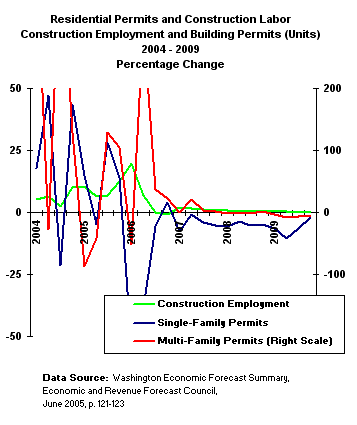
It is not so much that the lines of the future look improbably pacific compared to the radical agitation of the past. This is a function of using actual observations to inform the past and projections based on macroeconomic movement (i.e., ignorance) to inform the future. And it is not the seeming contradiction in the lines, where sometimes employment goes up as the other two go down, or vice versa. This has to do with the lag between permit and construction.
What troubled me was that the change in employment somehow stays above the changes in the projected permit activity. The difference may look tiny on the chart, but the green line stays higher. Construction firms don't have you on the payroll unless you're working. What gives? If anything, it should be lower.
I asked my friend (... I like him, he tolerates me ...) in construction trades. [Now this gets interesting, so follow along to the end.]
Commercial construction, says he.
I said, of course, "What commercial construction?"
The Olympics is drawing construction labor from north of Seattle. Snohomish County has broken ground on a $4.1 billion sewage treatment plant. Sound Transit is all over the light rail in Seattle, and that's going to go on for awhile. DOT projects, including the second Tacoma Narrows bridge, are going full steam, and Olympia and the Port of Tacoma have just signed off on a study of a rail coordination facility in the South Sound.
Public works! That's what commercial construction! The Keynesian in me loves it.
That is very interesting, but here is the really good part:
Skilled construction work is in demand and will be in demand over the next half dozen years. The kind of work that is done on these complex, long-term projects. If you need a career and don't mind union benefits, union wage scales, being reliable and being motivated, get hold of one of the union apprenticeship programs. This is not $8 per hour framing that is over at the end of the season. It is skilled work, and it is not particularly seasonal, and there are openings. The union programs are the best, says my friend, and biggest.
Unskilled or semi-skilled workers are going to be looking around for other jobs after residential building tapers off, and it likely mean significant dislocation and stress for some of us, both newcomers and others. But skilled workers are at a premium. Some projects go unstarted because there aren't enough skilled workers for the top layer to graduate into site supervision. That is, the tools are needed, so upward mobility is retarded.
So, clink! To public works! Good employment. Better infrastructure for everybody. And support under demand for local businesses. Your tax dollars at work. Clink!
NOTE: Anyone who wants to explore apprenticeship opportunities in Washington should start at the Labor & Industries website www.lni.wa.gov that shows a full listing of the programs and application procedures.
Saturday, July 29, 2006
Saturday at the Races
Washington's 4th District runs from Chelan down through Wenatchee, Ellensburg, on into the Yakima Valley, all the way to the Tri-Cities. It is currently represented by House Corruption Committee Chairman Doc Hastings. He has a formidable challenger in Democrat Richard Wright. (See our interview with Wright.) This seat is as ripe as an apple in October and ready for picking. Contributors and, particularly, volunteers can make a big difference here.
Hastings has not quit the other Washington, where he will no doubt remain even after his defeat, in the offices of one or another lobbying firm, to collect some of the vouchers he has accumulated. But he has begun to show signs of discomfort. His web site has been updated for the first time in two years.
His weekly letters back home studiously ignore the Iraq War or Hastings' role as Coverup in Chief to the most corrupt Congress of the past one hundred years. Immigration is also not present as an issue. He does mention the Ice Age, which has some association with the environment, I suppose. And he does try taxes, where his "responsible tax relief" is, as you might guess, code for the irresponsible tax giveaways to the wealthy that have lifted the burden of $7 trillion in new debt onto our and our children's' shoulders.
Symptomatic of Hastings contribution remains his role in holding the vote open on Medicare Part D long enough for billions in corporate profits to squeeze through. Completely descriptive of his integrity and moral force has been his chairmanship of the House Ethics Committee.
As Ethics Watchdog he has been a Lapdog. He kept the lights off Republican indecencies without major exception. Light has come in other windows, to be sure; Duke Cunningham is in jail; Hammer DeLay has resigned; DeLay and others are being actively prosecuted. A more complete accounting will arrive with a Democratic victory in November, should that blessed day ever arrive.
But Hastings has been ever the loyal corporal in the Right Wing Army, doing what he is told, marching our soldiers in front of him into Iraq, deeper into Iraq, facilitating the feeding of the predatory corporations on his constituents, and generally making nice with the nasty.
The Democratic Party has chosen to soft pedal this race. Republicans attack their enemies with big dollars and smear. Tom DeLay was famous for it. Why the party establishment ignores this one is beyond me.
Hastings is the poster boy for what is wrong with Congress. When he finally has to defend himself in public, he'll be in plenty of trouble.
Wright, on the other hand, is a genuinely capable man and a genuinely good person. He has a lot of energy and a good plan. Right now he's organizing 600 volunteers for the next push. If you have phone skills, personality, experience, or just motivation, you could be a part of a major grass roots coup. Learn more and sign up to volunteer here.
Gasbag Politics
In a last-ditch effort to make Dave Reichert seem somehow relevant, the Republican campaign spin machine moved in to give him his first semi-meaningful bill since he entered congress.
In the account, Dave Reichert had virtually complete command of the facts and twisted arms in the effort to push through his first major piece of legislation last week. In fact, that should read Dave Reichert had virtually complete command of his arms and twisted facts in his account of a very minor piece of legislation last week.
When HR 5852 becomes law, one more bureaucrat will be hired into the Department of Homeland Security, no doubt the son of a Republican fundraiser. Otherwise the federal action will be another study. The most significant thing it did was to withhold federal money unless the states jump through another hoop. The 21st Century Emergency Communications Act was more notable for its gasbag prose than its influence on anything of substance.
I know, when you hear grandiosity like the 21st Century Emergency Communications Act you grab for your wallet, like the states did last week for the Business Activity Simplification Act, which would have made life much less simple in some states, like ours, and easier only for the interstate corporations allowed to skate on their taxes. But Dave had an even better title for the bill on his website: The Reichert Emergency Communications Bill.
In fact, the bill was co-written by the ranking Democrat and basically scripted in four hearings the committee held. He is referred to as "Freshman Chairman" Reichert, although his chairmanship is of a minor subcommittee whose name is longer than its significance.
The website presentation gets points for nerve, like when the Chairman of the Committee on Homeland Security is quoted as saying "This bill will help save lives ... Without [Reichert] this important piece of legislation would not have been possible." Right. And this finger is holding up the moon. The bill passed the House 414-2, proving both that Dave was not needed and that the bill itself was politically insignificant.
Still, Reichert now gets to use active verbs, like "establishes" a position, "requires" an assessment, "facilitates" meetings, "elevates" importance (a very good example). Dave's previously authored bills ran to getting obscure truck parts into the country without tariffs, I believe, and did not require the gasbag ghost writers or even public notice. His previous press releases had to be satisfied with "touts," "congratulates," "applauds," and occasionally, I suppose, though I don't remember seeing it, "deplores." Not nearly on the level of "elevates."
Subscribe to:
Posts (Atom)